

School Boycott
CHICAGO, 1963
Civil rights issues were on many Americans’ minds in 1963, such as segregation, racial violence, income disparities, education access, and voting rights, among others. The growing movement was hard to ignore, even if you didn’t participate. Activists protested racial segregation nationwide. The battles were difficult, often violent, and fought without a guarantee of victory.
In the spring, youth in Birmingham, Alabama, emptied schools to demonstrate against harsh segregation in their city, and many ended up in jail. In late summer, the focus shifted to Washington, DC, when 250,000 Americans marched for jobs and freedom. By fall, the movement had come north to Chicago.
Separate and Not Equal
Students in Chicago in 1963 couldn’t choose where to go to public school. They had to attend the one in their neighborhood. Since the city’s neighborhoods were either Black or white, so were its schools. Public schools in Black neighborhoods were often outdated and always overcrowded.
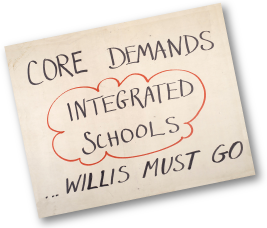
Although the Supreme Court’s Brown v. Board of Education of Topeka decision made segregated public schools illegal, Chicago’s Superintendent of Schools Benjamin C. Willis wouldn’t budge on integration. Rather than allow Black and white students to attend school together, Willis’s solutions to overcrowding included double shifts, or timed education blocks, which meant students would only attend school for four hours instead of a full day. He also introduced mobile classrooms. Willis’s opponents called these overcrowded aluminum units with no heating or cooling “Willis Wagons.”
Marching for Change
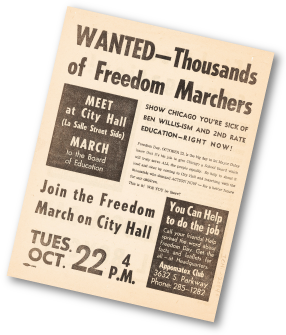
On October 22, 1963, a coalition of civil rights groups staged Freedom Day, a mass boycott and demonstration against segregated schools and inadequate resources for Black students. More than 220,000 Chicago Public Schools students boycotted class that Tuesday. Their protest left many schools serving Black students virtually empty.
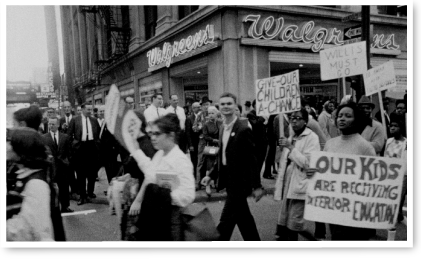
The climax of Freedom Day was the march to the downtown Chicago Board of Education building, where Superintendent Willis had his office. The Student Advocates of Negro History, a student group from Wendell Phillips High School, kicked off the protests early in the morning. Thousands took to the streets, carrying signs that voiced their frustrations, many targeting Superintendent Willis. Newspaper reports estimated as many as 120,000 people gathered outside the building by the end of the day. Police met the nearly 10,000 protestors and prevented them from entering the Chicago Board of Education building.
At the time, the protest was the largest northern antisegregation demonstration. The protest ignited other demonstrations, each demanding an end to segregation in Chicago. Change occurred slowly, as some Chicagoans opposed the Civil Rights Movement, but this activism led to increasing support for integration and revealed that racial segregation extended beyond the South. Actions continue today to make access to education accessible, relevant, and responsive.
